Sydney Church of England Grammar School (Shore) Chapel
Blue Street, North Sydney
Holroyd & Edwards (1923) with additions by Darrell Pitchford (2003-6, 2012, 2016, 2020) (3/38 electro-pneumatic)
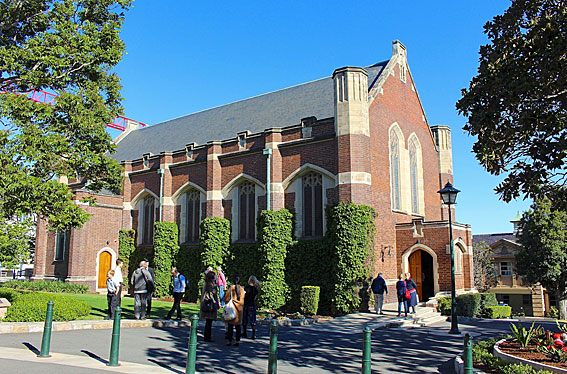
Shore Chapel (Photo: Trevor Bunning Oct 2018)
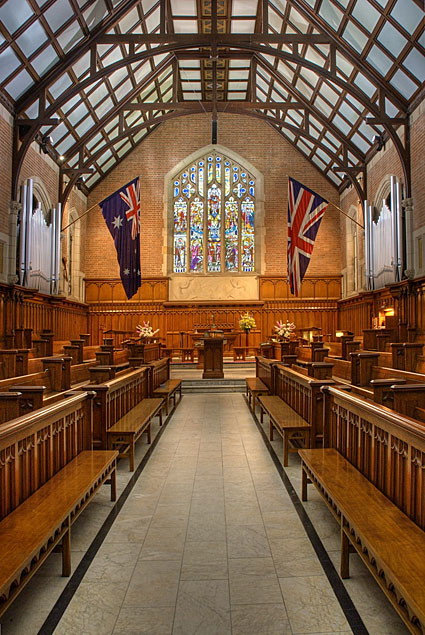
Photo: Dean Yates
History
From SOJ February/March 1987, Summer 1994-95, Spring 2003, Autumn 2004 and Robert Fox (chapel organist) March 2006:
In the days before electric blowing became common place, organ tuners would engage casual help at each church they visited. For payment of a few pence, one or two local lads would be found to hold keys and work the blowing lever. At St Silas' Anglican Church, Waterloo, one of the boys so engaged was Tom Edwards. He became fascinated with the craft of organ building and eventually was apprenticed to Charles Richardson at age 13 or 14.
Edwards was born in the Sydney suburb of Waterloo on 19 January, 1889. During his time with Richardson, Edwards was largely occupied with working on be Wm Hill & Son organ in Sydney Town Hall. Richardson had obtained the tuning contract in 1903 and successfully tendered in be following year for repairs, renovations and alterations to the Grand Organ. When this work was completed, regular tuning and maintenance required Edwards to be in almost constant attendance.
Tom Edwards joined the firm of Gregory Griffin and Charles Leggo when they commenced their partnership in 1911, apparently without loss of Richardson's goodwill. The Griffin & Leggo partnership dissolved towards the end of the First World War, and in 1917 Edwards set up on his own account at 127 Point Street, Pyrmont. From 1919 to 1924, Edwards was in partnership with John Holroyd who had been the N.S.W. Representative of Norman & Beard Ltd of Norwich.
The 1920s was a period of continuous growth for Edwards and in 1925 he purchased Richardson's tuning round. Tuning and repairing Theatre organs became a specialised and substantial part of the firm's work.
Edwards assisted John Whiteley in installing the latter's instrument for St Andrew's Anglican Cathedral in 1929/30.
Right up to the time of his death in 1960 (at 71 years), Edwards carried on a tuning round of 17 organs. Following his death, the tuning round and stock of spare parts etc, was sold to Hill, Norman & Beard of Melbourne.
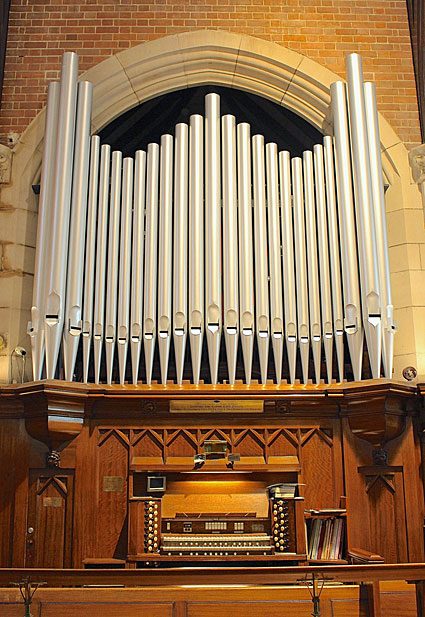
Shore Chapel organ (Photo: Trevor Bunning Oct 2018)
Organ Description
The organ at Shore was built in 1923 by Holroyd and Edwards with tubular pneumatic action. The chapel, with panoramic views over the harbour to the city, has a generous acoustic. With the use of the Super Octave coupler, the organ sounded like it had much more than just 8' and 4' stops. It was rebuilt by Pitchford & Garside in 1980 when the action was electrified.
Original Holroyd & Edwards (1923) specification:
Great
- 8' Open Diapason No.1
- 8' Open Diapason No.2
- 8' Hohl Flute
- 8' Dulciana
- 4' Principal
- 4' Harmonic Flute
- 8' Trumpet
Swell
- 8' Violin Diapason
- 8' Rohr Flute
- 8' Salicional
- 8' Voix Celeste
- 4' Gemshorn
- 8' Cornopean
- 8' Oboe
- Tremulant
Pedal
- 16' Open Diapason
- 16' Bourdon
- 8' Bass Flute
Couplers
- Swell to Ped
- Great to Ped
- Swell to Great
- Swell Octave
- Swell to Great Octave
- Swell Sub Octave
- Swell to Great Sub Octave
Compass 61/30
Tubular-pneumatic action (replaced with electro-pneumatic action in 1980)
4 Combinations Pistons to Swell
4 Combination Pistons to Great
Swell to Great Reversible
Great to Pedal Reversible (duplicated as Toe Stud)
Balanced Swell Pedal
Current specification (2020):
Great
- 16' Bourdon
- 8' Open Diapason No.1
- 8' Open Diapason No.2
- 8' Hohl Flute
- 4' Principal
- 4' Harmonic Flute
- 2' Fifteenth *
- III Mixture 19.22.26 *
- 8' Trumpet
- 8' Grand Trumpet *
Swell
- 8' Open Diapason
- 8' Salicional
- 8' Voix Celeste
- 8' Flute
- 4' Gemshorn
- 2' Fifteenth
- III Mixture 15.19.22 *
- 16' Contra Fagotto *
- 8' Cornopean
- 8' Oboe
- Tremulant
Choir
- 8' Lieblich Gedackt
- 8' Dulciana
- 4' Principal
- 4' Flute
- 2 2/3' Nazard
- 2' Harmonic Piccolo
- 1 3/5' Tierce
- 8' Clarinet
- 8' Cor Anglais
- 8' Grand Trumpet
- Tremulant
Pedal
- 32' Harmonic Bass *
- 16' Open Diapason
- 16' Bourdon
- 16' Lieblich Bourdon
- 8' Bass Flute
- 16' Trombone *
- 16' Bassoon *
- 8' Tromba *
Couplers
- Swell to Ped
- Great to Ped
- Choir to Ped
- Swell to Great
- Choir to Great
- Swell to Choir
- Swell Octave
- Swell Unison Off
- Swell Sub
- Choir Octave
- Choir Unison Off
- Choir Sub
Electro-pneumatic action (1979)
Compass 61/30
6 thumb pistons per manual division
16 general pistons
7 reversibles
Full Organ reversible (Thumb and Toe)
Sequencer with + and – pistons
Console assistant + and – pistons under keyboards (bass side)
Set and cancel pistons
64 divisional/general memories
2 balanced swell pedals
Wind Pressures
- Great: 3 7/8"
- Swell: 4"
- Grand Trumpet/Trombone/Tromba: 6"
* added 2003 – 2006 Pitchford & Garside
^ added 2012 DA & CM Pitchford
~ added 2016 DA & CM Pitchford
§ Added 2020 DA & CM Pitchford
1938 pipes
32 ranks
38 stops
52 drawknobs
2 tremulants
14 Couplers
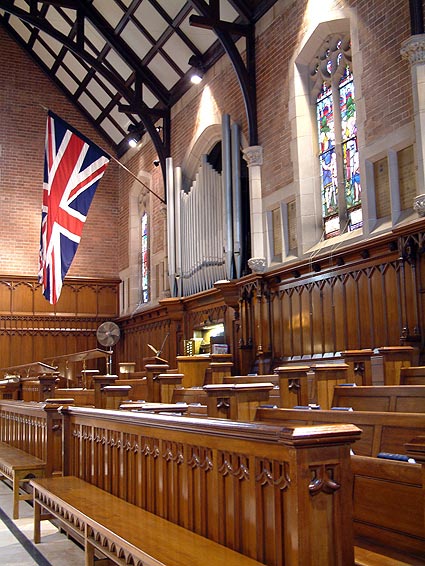
© PdL 2006
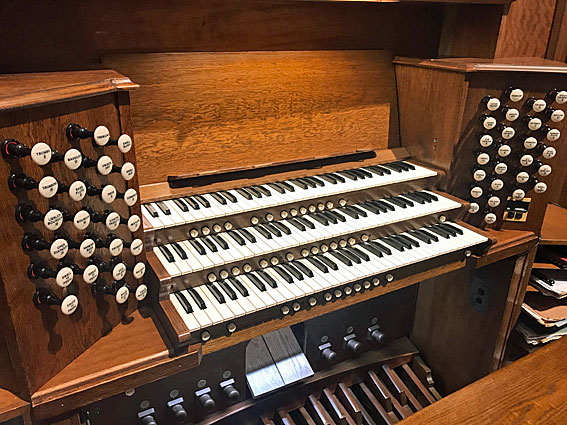
Shore Chapel new organ console [Photo: Robert Fox (June 2020)]
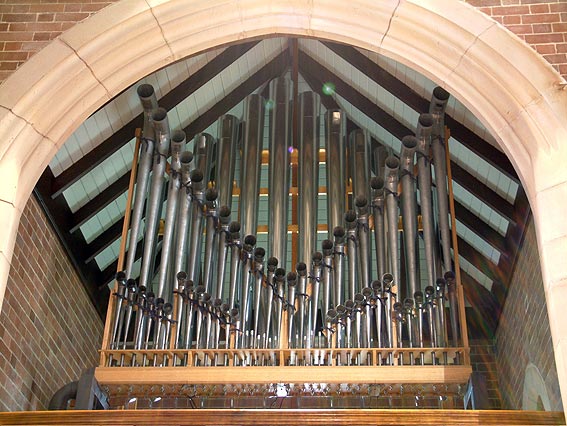
New division before new case added
© PdL 2006
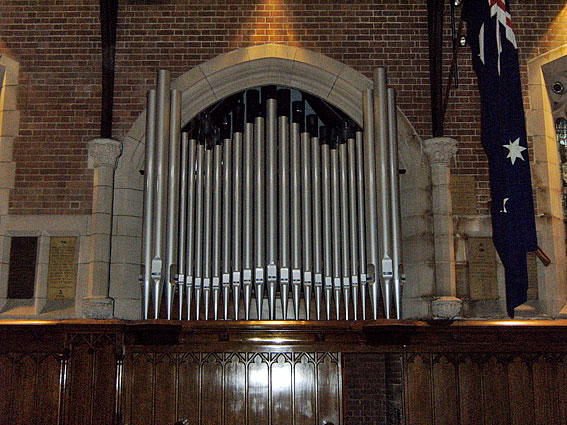
With new case added (2008)
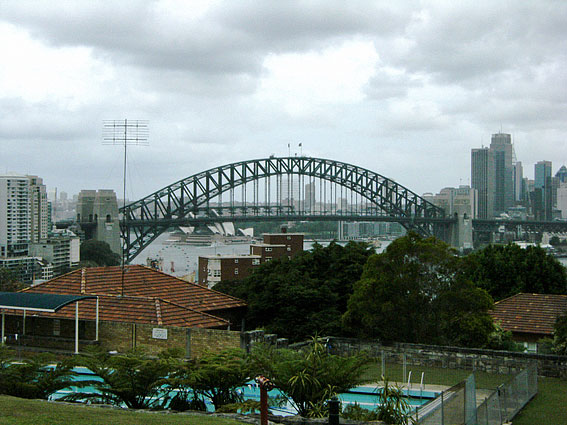
View from chapel
Photos: Mark Quarmby (Nov 2008)