St John-the-Baptist Catholic Church
Cnr Cowpasture Road and Mount Street, Bonnyrigg Heights
1879 Henry Bevington & Sons, 2m., 16 sp. st., tr.
(ex St John the Baptist Anglican Church, Hobart)
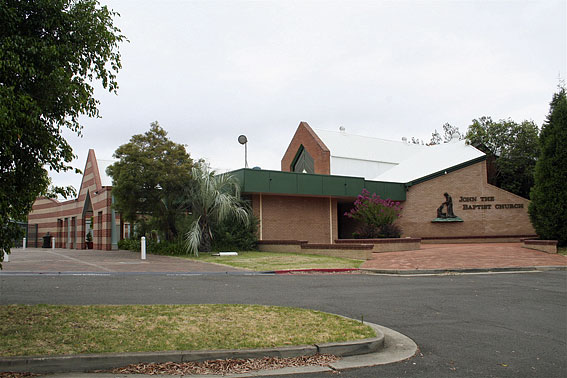
Trevor Bunning (Jan 2009)
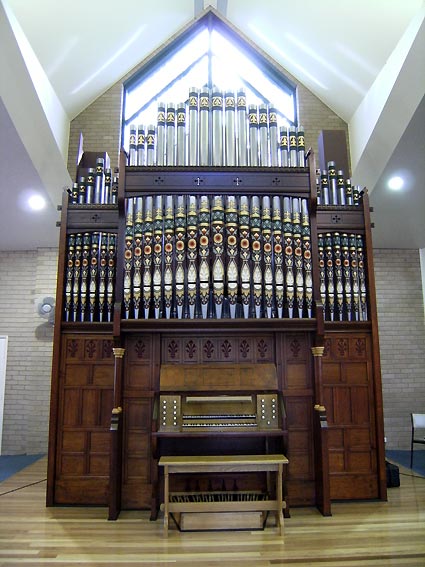
The parish of Bonnyrigg Heights purchased the redundant organ from St John the Baptist Anglican Church in Hobart in 2006. This organ was the second to be erected in St John's and came from Henry Bevington & Sons, Rose Street, Soho, London in 1880. The organ was moved to a new organ chamber in a new chancel when the church was extended in 1902. The church closed some years ago and was converted into a dance school with the chancel area being converted into the owner's residence. The organ was in the owner's bedroom and was inspected by members of OHTA during the 2002 Conference, the owner then wishing it to be sold and removed. The organ was installed and restored at Bonnyrigg in 2007 by Mark Fisher of Pipe Organ Reconstructions.
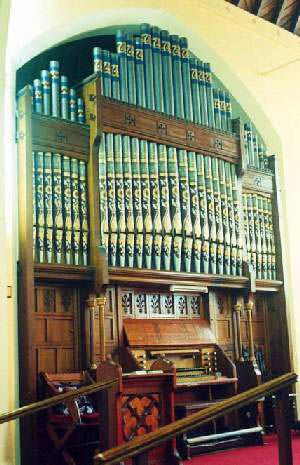
Photo from OHTA website
From the Spring 2007 SOJ, Mark Fisher writes:
After 127 years in Hobart, this well known BEVINGTON & SONS organ has now been restored in Sydney and is currently being installed at John the Baptist Catholic Church at Bonnyrigg Heights by Mark Fisher of Pipe Organ Reconstructions Pty Ltd. It is well equipped now to begin a new life in completely different surroundings.
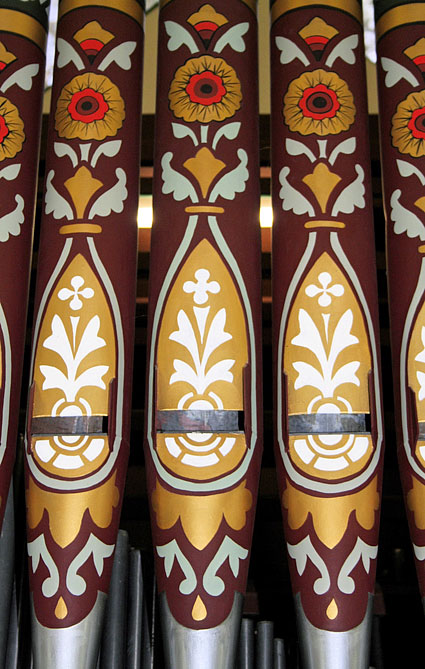
The organ was built in 1879 in London for St John the Baptist Anglican Church, Hobart and is BEVINGTON & SONS job number 1230. It was described by Bevington in December 1879 as "for St John's Hobart Town. - enclosed in a gothic screen case bracketed forward with richly decorated pipes of white ribbed metal."
The organ became redundant in the late 1990s after the church was closed and the building sold, complete with the organ. In April 2006, Fr Michael McLean and the Bonnyrigg Parish appointed Jim Forsyth as their consultant as they searched for a suitable pipe organ for the church. They approached Mark Fisher to find and recommend a redundant organ and he immediately suggested the Hobart organ. The church subsequently purchased the organ from the owners in Hobart and in June 2006, Pipe Organ Reconstructions went to Hobart to dismantle and pack the instrument into a container for its journey to Sydney.
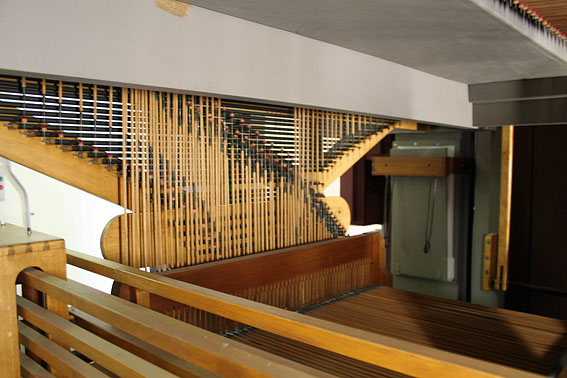
The organ is of 2 manuals and pedals and contains 16 speaking stops, 3 couplers and 5 composition pedals. There are 777 pipes and the pedal organ contains a full length 16ft Open Diapason. A new floor has been built in the church for the organ and the area behind the organ completely insulated from sunlight and heat. The instrument is free-standing in the building and speaks clearly into a somewhat reverberant space.
The original hand-pumping mechanism is being reconstructed, so that the organ may once again also be hand-blown. The 31 façade pipes, made from 'white ribbed metal' - Bevington's specialty, have had more recent re-paintings stripped off and the still-discernible original design reproduced again. Two sections of the pipes, originally featuring bands of dull blue at the tops and two-tone grey at the mid-section, have now had those sections re-painted in shades of green to pick up on the church's interior window fittings and door frames.
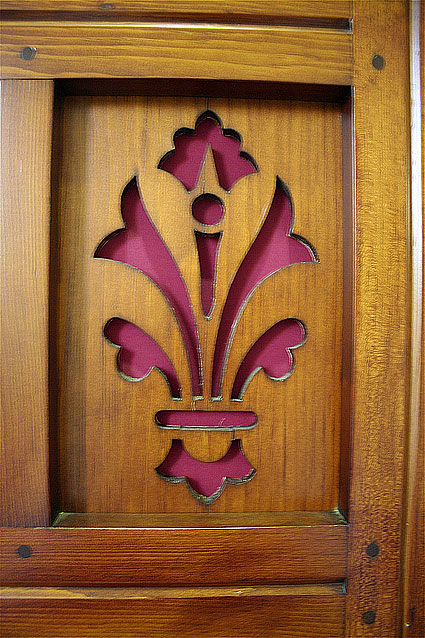
The front casework of the organ has been returned to its original format. In 1903 the organ was moved to a new position in the church at Hobart and the side flats of the front façade and case were moved forward about 300mm to fit a new chamber archway. These flats have now been put back to their original position. This, together with other alterations made to the case at that time, has resulted in the need for a great deal of cosmetic surgery and reconstruction of some posts and other sections of the case, using matching timbers. In the process, the whole was stripped back to bare timber and re-stained and polished.
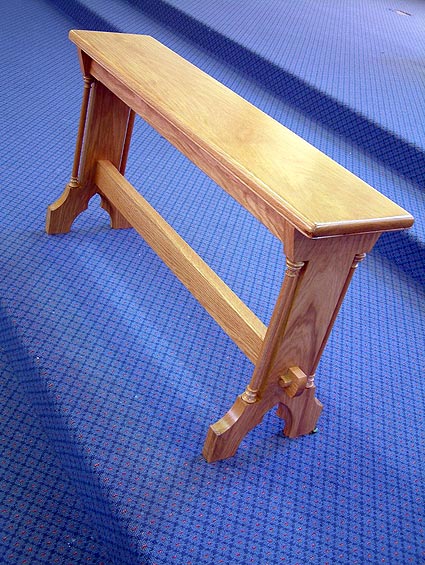
The 1903 organ bench was sold with some fittings with the church, but would have been unsuitable because, at the move, the floor at the console was raised nearly 200mm and the Pedal board and front case recessed into the floor necessitating a new bench at that time. In 2007, a new bench of European Oak was designed by Mark Fisher, in the style of another Bevington bench in England. This design features four turned columns on the bench which partner four columns around the console.
All painted sections of the organ's interior, together with the wood pipes, have been repainted in colours exactly matched to the original; even the lettered stencils on the floor frame, building frame and pipe racks have been faithfully reproduced to match exactly and these repainted directly over the original positions.
The interior metal pipework, made from an unorthodox high-tin alloy, peculiar to Bevington, is in an outstanding state of preservation and has been cleaned, with spectacular results. The original standard of workmanship, obvious in every aspect of this instrument, is typical of Bevington's superior quality, both in design and manufacture and features much that is never seen with any other builder. Expensive and very stable timbers were also used throughout and extraordinary lengths gone to in order to protect the bellows, windchests, frame, wood pipes and casework from the effects of the Australian climate. Restoration of the double-rise bellows reservoir and feeders, as well as the windchests was not begun until these had experienced the effects of a Sydney summer.
A new Ventus blower has been installed at the rear of the organ, together with its attendant blind valve, silencing box and muffler chamber. Because of Government safety laws, the organ has had to be located one metre away from the rear wall, to provide legal access to two emergency exits behind the organ.
Other work and some unhelpful alterations, carried out in 1903 by George Fincham at the time of the organ's move, were either reversed in this restoration or executed in a more suitable manner. Further work alluded to in writings since 1903 was found to be incorrect or wrongly assumed. Complete details of all work carried out during the 1903 move together with all details of the 2007 restoration will be given in a future issue of the Journal.
There is no doubt that this instrument, now free-standing, will provide a fascinating revelation into the work of Bevington & Sons that has not always been seen or heard in Australia.
The Bevington organ was opened on Sunday 18th March 2008 at a Solemn Pontifical Mass with James Dixon, conductor, and James Goldrick, organ. Kurt Ison played the inaugural recital the same afternoon, with associate artists.
The specification is:
Great
| Open Diapason | 8' | M |
| Claribel | 8' | W - stopped bass to TC |
| Horn Diapason | 8' | M - shares stopped bass with Claribel to TC |
| Dulciana | 8' | M |
| Principal | 4' | M |
| Harmonic Flute | 4' | M |
| Twelfth | 2-2/3' | M |
| Fifteenth | 2' | M |
Swell
| Bourdon | 16' | stopped wood, separate slide |
| Double Diapason | 16' | C-B M |
| Open Diapason | 8' | M - shares stopped bass with Bell Gamba to TC |
| Bell Gamba | 8' | M - stopped bass to TC |
| Principal | 4' | M |
| Fifteenth | 2' | M |
| Cornopean | 8' | M |
Pedal
| Open Diapason | 16' | W |
Mechanical action
Compass 56/25
3 composition pedals to Great
2 composition pedals to Swell
Hitch-down Swell pedal
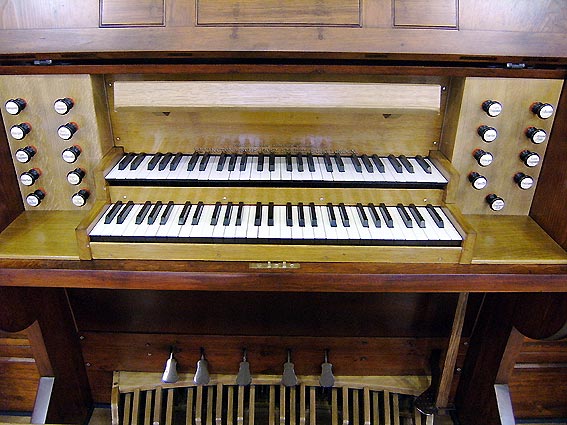
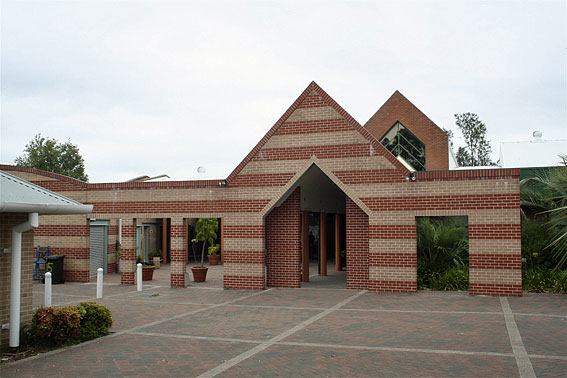
Trevor Bunning (Jan 2009)
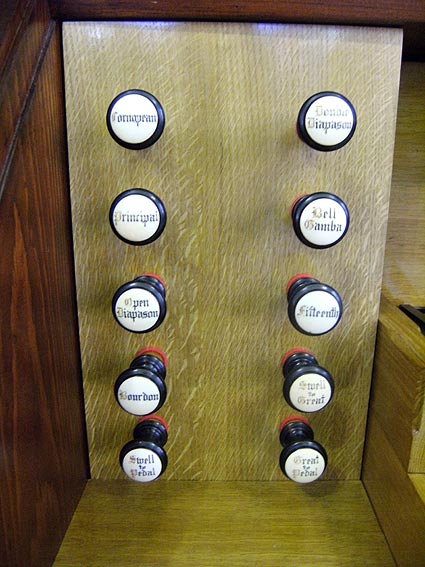
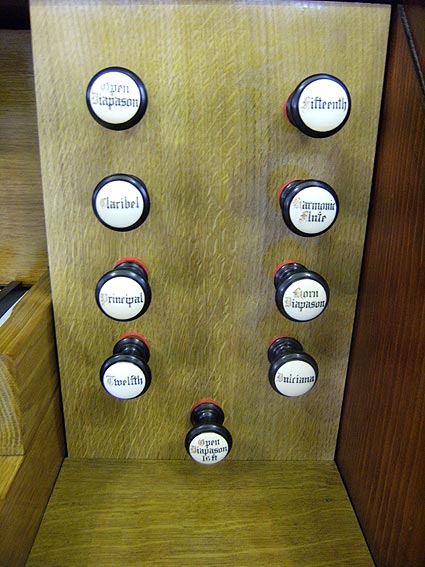
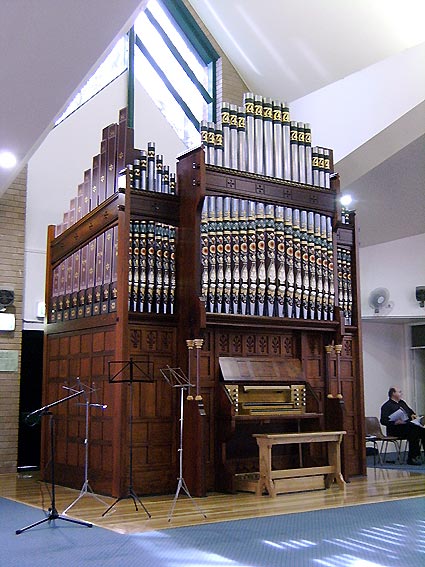
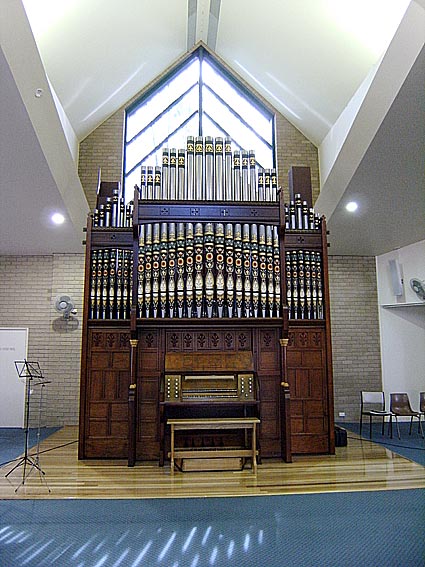
Photos above: MQ (Opening of organ 18 Nov, 2007)
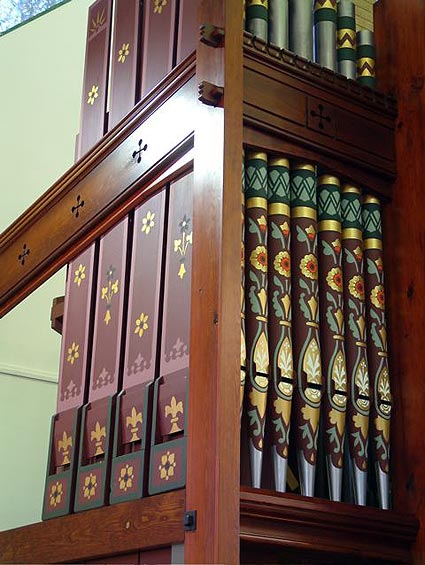
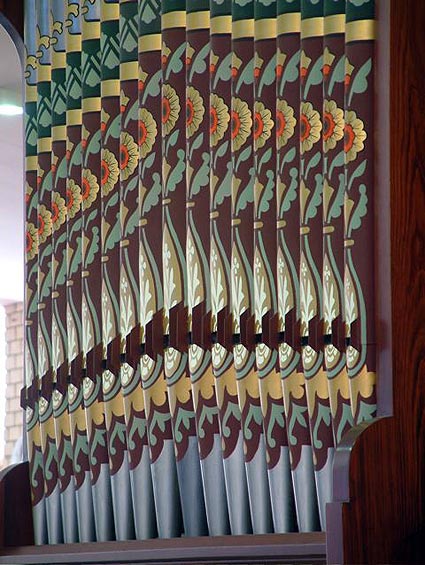
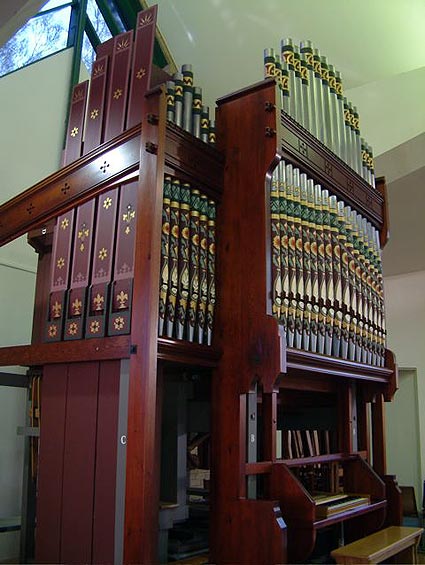
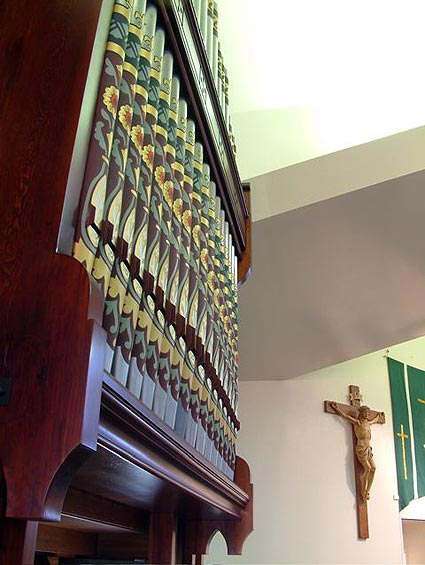
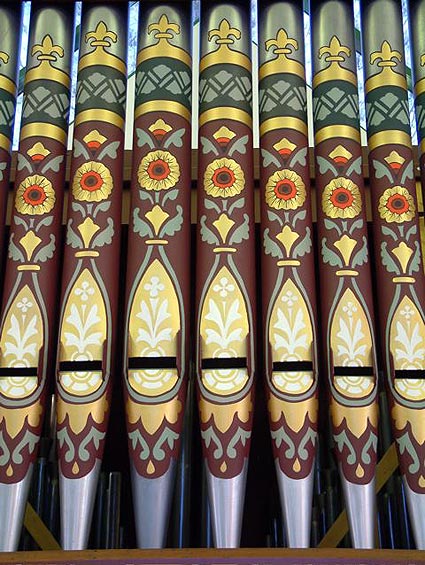
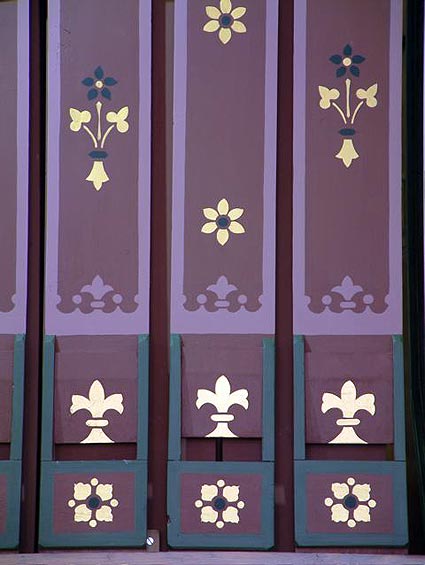
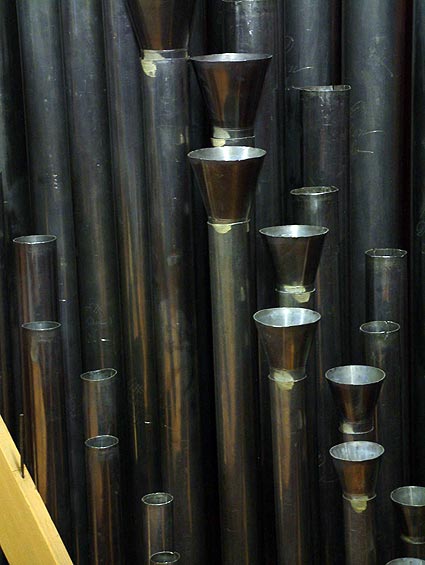
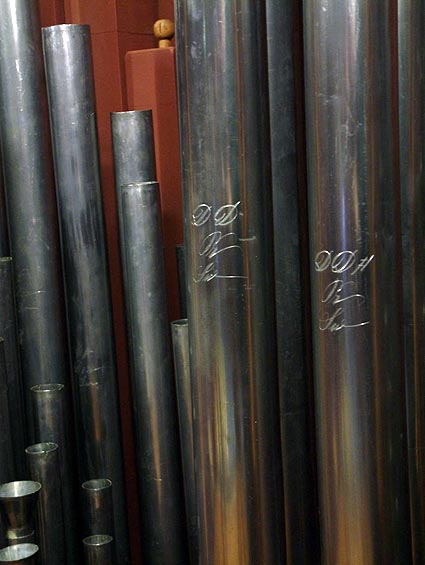
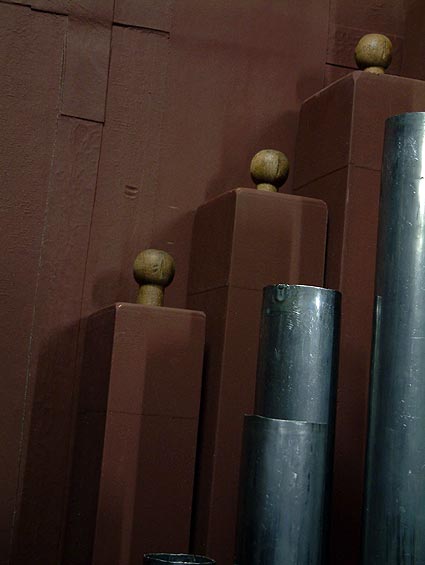
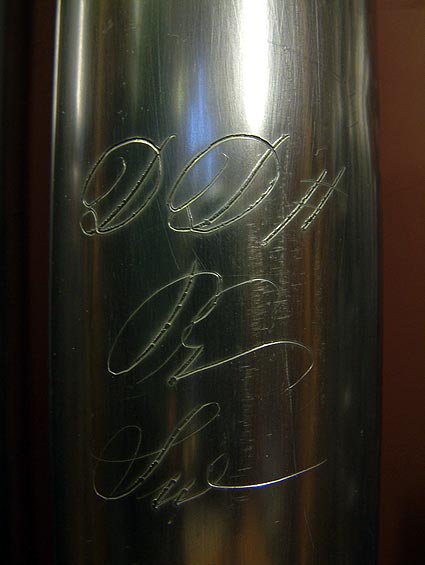
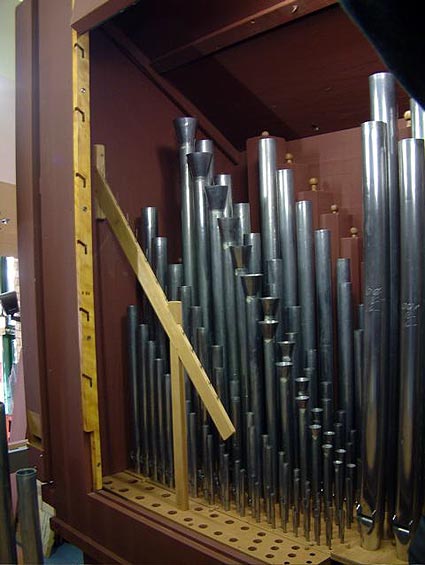
3 photos above: Trevor Bunning (Jan 2009)
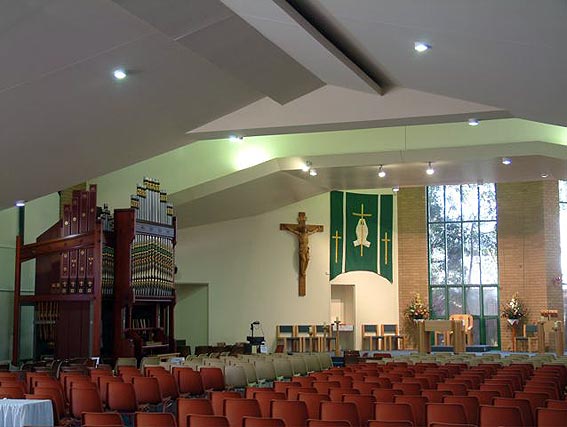
Photos taken by Pastor de Lasala 2007 (copyright)
A WORK OF ART RESTORED FOR A NEW START
ANOTHER BEVINGTON & SONS ORGAN FOR NEW SOUTH WALES
MARK FISHER WRITES
(Sydney Organ Journal, Autumn 2008)
HISTORICAL
The 1879 Bevington & Sons organ, opus 1230, formerly at St. John the Baptist Anglican Church, West Hobart, was blessed and dedicated at its new location by Cardinal George Pell, on Sunday 18 November 2007. The congregation of more than 1200, joined in the great occasion to welcome the organ at John the Baptist Catholic Church, Bonnyrigg Heights. Following a luncheon, Kurt Ison then gave the Inaugural Recital and Concert, ably assisted by Brett McKern, with soprano Jermaine Chau, trumpeter David Pye and violinist Sylvia Wong.
The latest addition to Sydney's many historic pipe organs has been recently restored by Pipe Organ Reconstructions Pty Ltd., and is an excellent example of the successful relocation of a redundant instrument from elsewhere in Australia. Sydney lost its first and largest Bevington & Sons organ to come to Australia, in the fire which destroyed St. Mary's Cathedral on 29 June 1865. The second, the 1888, 3/25 instrument remaining at All Saints Hunters Hill, is now joined by a smaller and older stablemate which, despite its size, is able to give a much better account of itself and its builder, by reason of a freestanding position in good acoustics. A further Bevington instrument, also for Sydney, was purchased by Pipe Organ Reconstructions Pty Ltd in 1995 and its restoration is now well advanced. The Bonnyrigg organ is a perfect example of the many hundreds of individually designed mid-sized instruments by this London builder that are still in use around the world. It displays every facet of Bevington's superior quality in their pipework, windchests and action, as well as great skill and artistry in design, workmanship and finish. Many innovations employed in their work are not seen with any other builder.
Bevington & Sons, of Soho, London, built more than 2000 organs1, including a number of really sizeable instruments, in twenty-five countries as well as the UK. They understood the importance of reliability, using simplicity and long-lasting quality; and they paid very close attention to every detail of their work. This was particularly true of exported organs; firstly, to ensure a perfect condition on arrival and, secondly, to permit ease of assembly of their instruments, wherever in the world they arrived. All organs exported by the firm were in every instance most carefully packed under the strict supervision of the principals. Their reputation for consistent high quality and superior packing of organs sent overseas, led to the firm having, at the close of the 19th century, the largest export business of anyone in the trade2. Bevington & Sons sent organs to Africa, Australia, Belgium, Bermuda, British Burma, British Guiana, Canada, Canary Islands, Costa Rica, Cuba, France, Gibraltar, Hungary, India, Ireland, Italy, Jamaica, Mexico, Newfoundland, New Zealand, North America, Quebec, Spain, Sandwich Islands (Hawaii), and the West Indies.
Opus 1230, of 2 manuals and pedals, with 16 speaking stops and 777 pipes, left Bevington's Rose Street Manufactury in Soho, London, at the end of November 1879, on board ship bound for Tasmania. It was described in a notice published in Musical Opinion of 1st December 1879 as "for St. John's Hobart Town – enclosed in a gothic screen case bracketed forward with richly decorated pipes of white ribbed metal."
From Bevington's information sent to a New Zealand church committee in 187711, an instrument the size of the one for Hobart would have been be completed within four months. The firm's yearly output around this time was 156 organs – or three organs per week.
Specification of the Organ
Great
| Open Diapason | 8' | M |
| Claribel | 8' | W |
| Horn Diapason | 8' | M, sharing Stopped Bass* with Claribel |
| Dulciana | 8' | M |
| Principal | 4' | M |
| Harmonic Flute | 4' | M |
| Twelfth | 2-2/3' | M |
| Fifteenth | 2' | M |
Swell
| Bourdon | 16' | stopped wood, separate slide |
| Double Diapason | 16' | W & M |
| Open Diapason | 8' | M |
| Bell Gamba | 8' | M, sharing Stopped Bass* with Open Diapason |
| Principal | 4' | M |
| Fifteenth | 2' | M |
| Cornopean | 8' | M |
Pedal
| Open Diapason | 16' | W |
Mechanical action
Compass 56/25
3 Composition Pedals to Great
2 Composition Pedals to Swell
Mechanical action throughout
Hitch-down Swell Pedal
Flat Radiating Pedal Board
* Stopped Bass pipes on Great and Swell are not on separate drawstops, but draw automatically as required.
Ventus blower: wind pressure 70mm (2 ¾")
The opening of the organ at St. John's was written up in Church News; 1/5/1880, p71: "The organ has been erected in the church by Mr Wm Anderson3, of Melbourne, who speaks in the highest terms of the care and workmanship bestowed upon it by Messrs Bevington." J. Finch Thorne, brother of E.H.Thorne (Organist of St. Anne's Soho, London), supervised the installation and played the opening recital4. The organ stood, freestanding, at the east end of the north aisle, until structural problems in the east end wall of the church became evident in 1900. Finally, in 1902, the chancel was closed off and the east end of the church demolished. It was decided that the whole building could be improved if the chancel was extended further east, which would then allow the organ to be accommodated in a new chamber in the tower on the northern side5.
In 1903, George Fincham & Son, organ builders of Melbourne were entrusted with the job of taking down the organ, carrying out some alterations and re-erecting it in the new chamber. Fincham's quotation for the work6 is as follows:
GEO FINCHAM & SON CORRESPONDENCE RELATING TO ST JOHN-THE-BAPTIST ANGLICAN CHURCH, GOULBURN STREET, HOBART, TASMANIA
Volume 19:
1 June 1903, p.355
Rev Mr Atkinson [presumably the Rector]
Double acting generators & Melvin pattern engine constructed in gun-metal throughout with patent starting dial at key-boards together with all necessary frames, trunking, regulating gear, &c &c £50:0:0
Melvin pattern engine as described above, with necessary connecting rod, regulating gear &c &c £35:0:0 Kindly note that this work is fully guaranteed & includes everything necessary, excepting only the plumbing work, meter, stop cock &c
8 July 1903, p.415
Colonel A. Reid, Frederick Street, Hobart
Re: Organ St. John's Ch. Goulburn St.
Dear Sir:-
We have estimated the desired alterations to the above instrument as follows:-
| To clean, remove & re-erect | £30-0-0 |
|
" Place feeders on frames, reverse same to suit blowing & lengthen handle 18", alter position of draw-knobs of Great Open Diapason, Claribel, Principal & Twelfth also Swell Double Diapason & Fifteenth, making draw in proper order |
£9-0-0 |
|
" Provide 2 Composition Pedals to Swell together with necessary action |
£7-10-0 |
|
" Convey off two (2) pipes of Ped. Open to back of organ & draw the stop on Bass jamb |
£2-10-0 |
|
" Supply to the Swell : Gedact (or Stop Diapason) & Oboe, together with supplementary sound-board, action, &c &c, including necessary alterations to Swell-box |
£55-0-0 |
| " Reduce the power of the Great Gamba [sic] & Dulciana | £2-2-0 |
|
To bring forward the side flats of Front in line with present centre flat, altering side framing to suit &c |
£6-0-0 |
We cannot advise that the Swell Double Diapason be made available on the Pedal. The cost would not justify the alterations. It would be almost as expensive as a Pedal Bourdon
Provided the foregoing alterations + additions are carried out, the cost of cleaning & re-erecting organ (together with many minor details not specified) could be reduced to £25-0-0
The estimate for engine &c we have already supplied to the Rev. Mr. Atkinson, who has, we expect, handed the same to you.
We are
Dear Sir
Yours obediently
Geo. Fincham & Son
29 July 1903, p.452
L.V.H. Fincham and A. Ground to work on the job in Hobart
19 August 1903, p.490
Mr C. Nuttall (GF&S staff)
Engine + generators packed ready for shipment, there are 3 packages, generators, Clarionet, glue, collars & conveyance stuff, Engine bolts &c. Generator framing & trunk stuff, they will be shipped by the "Flora" leaving here on Friday at noon, this is a direct boat.
31 August 1903, p.515
Mr C. Nuttall
"…sorry to hear that the packing case was all to pieces"