Anglican Church Grammar School Chapel
Oaklands Parade, East Brisbane
FIRST ORGAN: Whitehouse Bros, Brisbane, c.1941
Installed 1942 Whitehouse Bros, Brisbane
Additions 1943, 1944, 1953, Whitehouse Bros, Brisbane
2 manuals, 5 ranks extended, electro-pneumatic action
Removed 1976 and broken up
PRESENT ORGAN: Roger H. Pogson, Sydney, 1980
2 manuals, 20 speaking stops, mechanical action
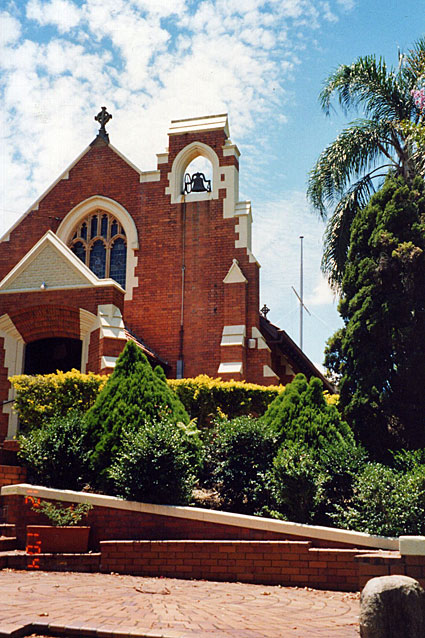
The Canon Jones Memorial Chapel, ACGS, East Brisbane
[Photograph by Geoffrey Cox (January 1990)]
Historical and Technical Documentation by Geoffrey Cox
© OHTA 2011, 2016 (last updated November 2016)
The Anglican Church Grammar School dates from 1912, when Canon W.P.F. Morris established the St Magnus Hall Collegiate School at 'Ardencraig' in Toowong. In 1913 it was combined with the St John's Cathedral School, and in 1914 with Bowen House Preparatory School to become the Brisbane Church of England Grammar School. Thirty-two acres of land in East Brisbane was acquired in 1917, and the school moved to its present site in 1918.1 Long known as 'Churchie', the school has since expanded to occupy most of the land on both sides of Oaklands Parade.
The main buildings of the school, built from 1918 onwards, were designed by the prominent Brisbane architects, Atkinson and Conrad, consistently using the interwar Old English style, featuring decorative gables, red face brickwork, and vertical proportions. The Canon Jones Memorial Chapel, built in 1923-24, also displays architectural features of the interwar Gothic style.2 It was dedicated on 4th May 1924 in memory of Thomas Jones (1836-1918), a pioneer priest of Queensland from 1860 onwards.
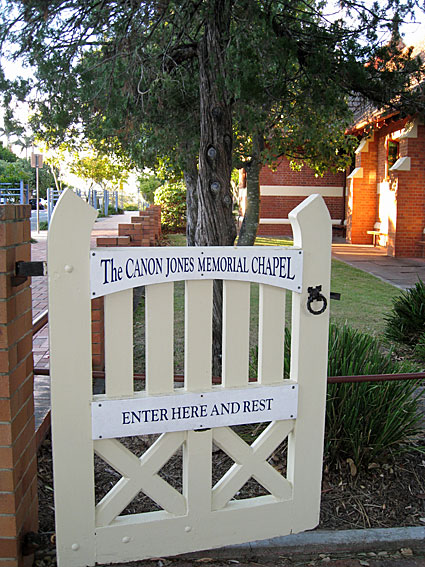
Gate to the School Chapel
[Photograph by Geoffrey Cox (July 2011)]
First Organ
It is recorded that a chapel choir had been formed as early as 1926,3 and that music in the chapel was accompanied at first by an Estey reed-organ. This was replaced in 1929 by a larger reed-organ, at a cost of £270.4
The first pipe organ in the chapel was installed by Whitehouse Bros of Brisbane in October 1942. The instrument was reportedly built 'on spec', and was pictured completed on the factory floor in 1941. It was purchased by Mr J.L. Mactaggart, who donated it to the school as a memorial to his son, an old boy of the school who had been killed in action.5
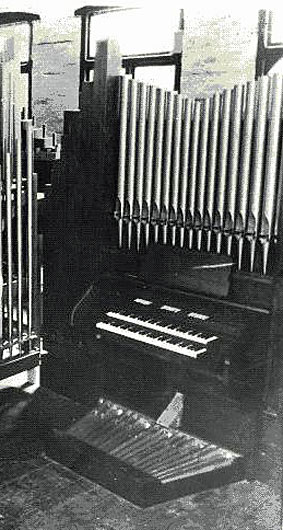
The first chapel organ on the floor of the factory
at Whitehouse Bros, Red Hill, c.1941
[Photograph from the archives of Whitehouse Bros, supplied by Howell Whitehouse]
Installed in October 1942, it comprised at first only two ranks extended over two manuals and pedals. Further stops were donated by Mr Mactaggart in Feb. 1943 (Clarabella 8ft), Oct. 1944 (Oboe 8ft) and March 1953 (Open Diapason 8ft),6 to provide a total of 18 stops:
| GREAT | SWELL | PEDAL |
|---|---|---|
| 8' Open Diapason [1953] | 16' Bourdon (Ten. C) | 16' Bass |
| 8' Clarabella (Ten. C) [1943] | 8' Flute | 8' Flute |
| 16' Bourdon (Ten. C) | 8' Salicional | 8' Salicional |
| 8' Flute | 4' Salicet | 8' Oboe |
| 8' Salicional | 4' Flute | |
| 4' Salicet | 2' Piccolo | |
| 4' Flute | ||
| 8' Oboe [1944] |
COUPLER: Great to Pedal [1953]
Tremulant
Attached stop-key roll-top console
Electro-pneumatic action
Radiating concave pedalboard
Compass: 61/30
Balanced swell pedal.7
Present Organ
The present organ is placed at the rear of the chapel, adjacent to the west door. This may possibly be explained by the fact that the seating in the chapel was for some time in the 1970s-80s re-oriented sideways to provide seating 'in the round' facing Oaklands Parade. The seating has since been restored to the original configuration, albeit with the sidelining of the original choir stalls.
The new instrument was built by Roger H. Pogson of Sydney in 1979-80, with Robert Boughen as consultant.11 It was substantially revoiced in 1987 by Michel Alcouffe of Melbourne.12 The Nazard 2-2/3ft stop, which had been 'prepared for' from the outset, was added in 2012 by W.J. Simon Pierce, who substantially re-voiced the entire organ at the same time.13
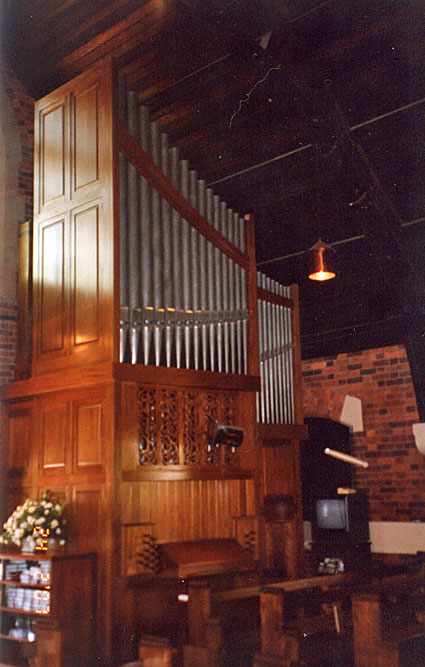
The Roger H. Pogson organ of 1980
[Photograph by Geoffrey Cox (January 1990)]
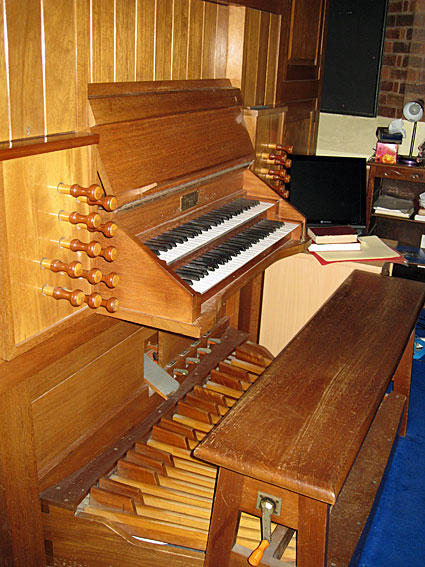
Console of the Roger H. Pogson organ
[Photograph by Geoffrey Cox (July 2011)]
| HAUPTWERK (I) | POSITIVE (II) (enclosed) | PEDAL |
|---|---|---|
| 8' Principal | 8' Gedackt | 16' Sub-bass |
| 8' Rohr Flute | 4' Principal | 8' Flute |
| 4' Octave | 2' Gemshorn | 8' Principal |
| 4' Flute | II Sesquialtera | 4' Choral Bass |
| 2-2/3' Nazard [2012] | 1-1/3' Quint | 16' Fagott |
| 2' Octave | III Mixture | 8' Trumpet |
| III Mixture | ||
| 8' Trumpet |
COUPLERS: II-I, I-Pedal, II-Pedal (foot levers)
Positive tremulant
Balanced swell pedal
Radiating concave pedalboard
Compass: 61/32
Mechanical action.13
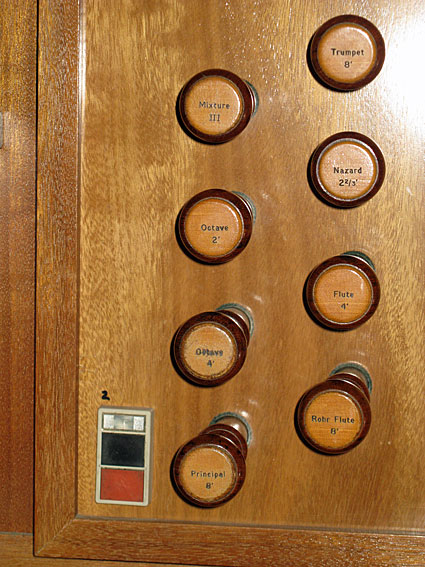
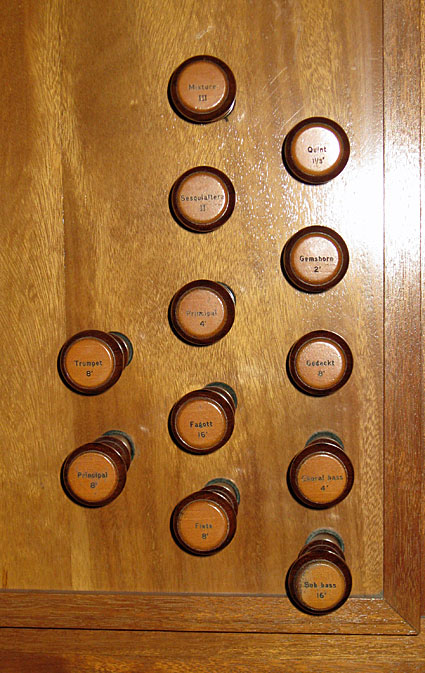
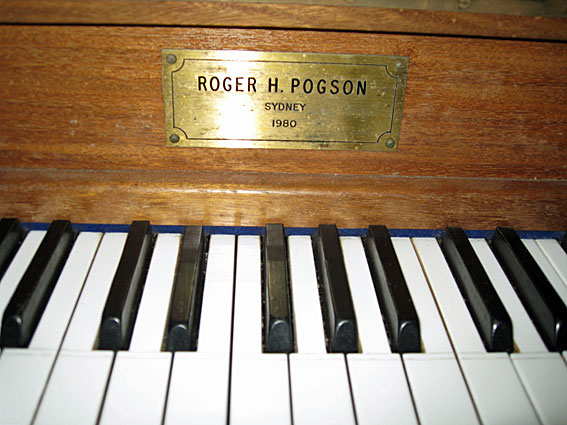
Stop jambs and builder's nameplate
[Photographs by Geoffrey Cox (July 2011)]